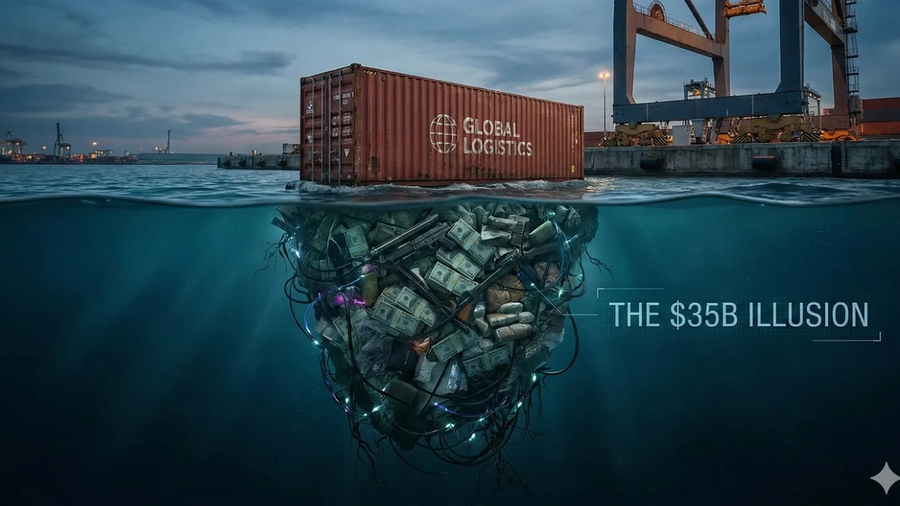
The $35 Billion Crime You’re Funding Without Knowing It
Cargo theft and organized retail crime are fueling global criminal networks — and costing the average American family over $500 a year. Here’s how supply chain fraud became a $35 billion problem
By Heesham Naji | December 30, 2025
Three days before Christmas, $400,000 worth of lobsters destined for Costco vanished somewhere between Massachusetts and the Midwest.
The CEO of the logistics company that lost them said something most people glossed over:
"“This theft wasn’t random. It followed a pattern we’re seeing more and more, where criminals impersonate legitimate carriers using spoofed emails and burner phones to hijack high-value freight while it’s in transit.”
This was the second major seafood theft from the same Massachusetts facility that month.
But here’s what the headlines missed: those lobsters aren’t feeding someone’s New Year’s party. That $400,000 is flowing into criminal networks operating across 30+ countries, trafficking drugs, humans, and weapons.
And you’re paying for it.
The Operation Nobody’s Talking About
Earlier this year, Homeland Security Investigations launched Operation Boiling Point. The name sounds dramatic. The reality is worse.
HSI isn’t chasing shoplifters. They’re targeting what they call polycriminal organizations — sophisticated networks profiting from organized retail crime, cargo theft, and a menu of illegal activities.
The same groups stealing cargo are trafficking fentanyl.
The same networks hijacking trucks are moving humans.
The money from that stolen lobster shipment flows through the same channels laundering billions in drug proceeds.
The FBI calls organized retail theft a “gateway crime.” The proceeds fund healthcare fraud, money laundering, and — in their words — potentially terrorism.
This isn’t hyperbole. This is the federal assessment.
The Numbers That Should Terrify You
- $35 billion in annual losses from cargo theft and organized retail crime
- 27% increase in cargo theft incidents in 2024
- Another 22% increase projected for 2025
- Average theft value: $285,000+
- Cargo theft represents ~58% of total retail-theft losses
But here’s the number that hits home: the average American family pays $500+ per year because of this crime.
That’s your grocery bill. Your insurance premiums. The price of everything that moves on a truck — which is everything.
The Cyber Connection
In November 2025, Proofpoint released a report that should have made front-page news.
Criminal cybergangs are now teaming with organized crime to steal cargo. They’re using legitimate remote monitoring tools like ScreenConnect and SimpleHelp to infiltrate freight brokers, conduct reconnaissance, and harvest credentials.
A separate campaign used DanaBot, a banking trojan linked to Russia-based cybercrime operations.
The attack chain looks like this:
Phishing email → malware → system access → stolen shipping documents → fictitious pickup → cargo gone
The criminals never touch the truck. They steal the freight from a laptop — possibly from another country.
Why Nobody Can Stop It
When Operation Boiling Point launched, AML experts pointed out a hard truth: there are no federal laws that directly target organized retail and cargo theft.
Prosecution is multi-jurisdictional. A load is stolen in Massachusetts, moves through three states, gets fenced online, and the money is laundered internationally.
Who prosecutes that?
Everyone’s problem becomes no one’s problem.
The Combating Organized Retail Crime Act (CORCA) is advancing in Congress. It would modernize statutes, expand forfeiture authority, establish a dedicated HSI hub, and improve information sharing.
But legislation moves slowly.
Criminals don’t.
What Happens Next
I’ve been tracking cargo theft data for months. Here’s my predictive outlook:
2025–2026
- Theft continues rising (22%+ annually)
- Cyberattacks on freight brokers accelerate
- Increased federal attention, limited enforcement tools
- Insurance premiums spike on high-risk corridors
- Major shippers begin requiring security certification
2027 and Beyond
- CORCA or similar legislation passes
- Federal Supply Chain Crime Coordination Center funded
- Identity verification requirements expand
- Market splits: secure operators vs. vulnerable targets
Brokers who build security infrastructure now position ahead of regulation. Those who don’t become the soft targets organized crime is actively hunting.
The Bottom Line
When you see a headline about stolen lobsters, don’t laugh. That’s the visible tip of something much larger.
Operation Boiling Point exists because cargo theft isn’t petty crime. It’s infrastructure for transnational organized crime — the same networks, the same money, the same national security threat serious enough for DHS to deploy 7,100 special agents.
You’re already paying for this crime — $500+ per year in higher prices.
The question is whether we keep funding criminal organizations through supply chain vulnerabilities, or finally do something about it.
The criminals made their choice years ago.
Time to make ours.
Found this useful?
Share it with your network or subscribe for more updates.
Subscribe to Briefing